While watching movies, have you ever wondered how one scene transitions to the next, builds emotions and keeps you hooked until the end? While the camera captures the raw images, it is the art of film editing that ensures continuity and shapes the audience’s experience.
Film editing is one of the critical aspects of the filmmaking process, as it determines the entire story. Because of this, film editing is often called the “invisible art” and, when done well, influences the visual and emotional journey of the audience.
So, if you are passionate about working in the film industry or simply want to know how the technique of making a movie works, enrolling in a film editing course at MAAC Serampore is one of the best ways to gain hands-on experience and learn the creative principles behind this craft.
What Is Film Editing?
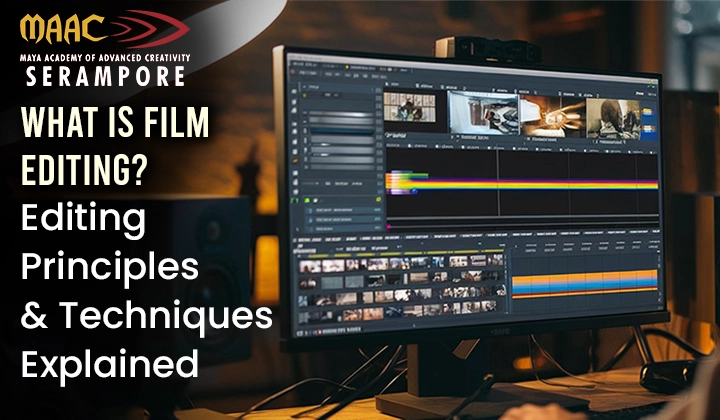
Film editing is a core part of the post-production process, which we call the final stage of filmmaking, when shooting has been completed. It is the process of selecting, arranging and assembling the raw video footage to create a compelling narrative.
Editing also involves adding special effects and transitions to make an engaging movie. Most people have an idea that editing is all about cutting and joining the scenes together to form a logical sequence; however, it is more than that.
Editing is often described as the “final rewrite” of all movies. It is the editors who carefully choose the best takes, decide the pacing of each scene, and establish a rhythm that keeps the narrative flowing smoothly.
Modern filmmaking involves both creative and technical skills. Editors now work with different software to adjust the footage with the audio, add visual effects and export the final product into different narratives, all while maintaining the clarity of the movie.
A film editing course at MAAC Serampore will equip you with the necessary skills to use advanced editing software, as well as understand the artistic side, like storytelling, rhythm and pacing. You will be able to gain practical experience and build a strong portfolio to start your career in media houses, digital platforms, OTT houses and television.
Key Principles Of Effective Editing
- Continuity: It is one of the common techniques that ensures every detail remains the same from shot to shot. Whenever a scene maintains the standards of continuity, each shot feels like an extension of the previous shot, helping the audience stay immersed in the story.
- Rhythm, pace and timing: The rhythm determines how quickly a shot changes. For example, editors use quick cuts in action sequences to create energy. On the other hand, emotional moments use longer takes to let the audience sink into the feeling.
- Emotional flow: A film’s purpose is to induce emotions. Hence, beyond the visual consistency, emotional continuity is also important to make sure that the audience stays connected.
Techniques Of Film Editing
Let’s take a look at the specific techniques editors use to create the narrative.
- Montage: It is a series of short video clips or shots set to music to convey a lengthy passage of time, a character’s emotional journey, or the summary of various events.
- Cross-cutting: It involves cutting together two separate scenes to show that two moments are happening simultaneously.
- J & L cuts: J-cut is where the audio from the next scene starts playing before the video cuts to it. On the other hand, an L-cut involves the audio from the previous scene staying after the video has cut to the next scene.
- Kuleshov effect: It is a phenomenon where viewers derive more meaning from the juxtaposition of two sequential shots than from a single shot in isolation.
Conclusion
Film editing is a rewarding career path with increasing job growth and a high package. If you are also passionate about exploring how cinematic magic is created on screen, a film editing course from a reputed institute like MAAC Serampore is the first step to prepare you for this profession.